


Crash barrier posts: H post or Z post?
Z post for low-speed knocks in car parks and yards; H post where the barrier protects racking, plant or a structural line. Dig in or bolt down on either.
The beam is the same whichever post you choose, so this is the decision that sets what the barrier will actually do. The honest way to make it is to ask what is behind the barrier and what happens if a vehicle gets there.
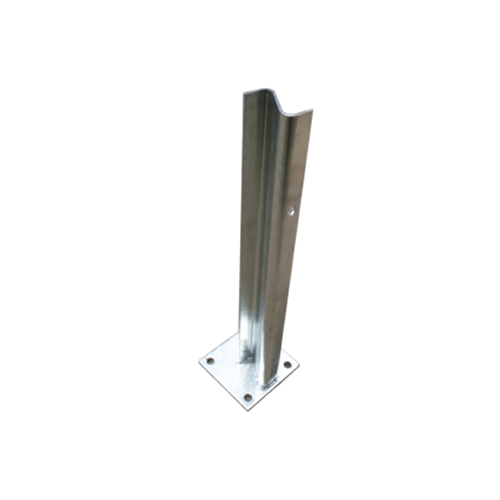
Z post — the car park post
100mm x 50mm section, hot dip galvanised, available as a 1.2m dig in or base plated at 560mm and 760mm overall. It is sized for the job most barrier actually does: stopping a reversing van from clipping a wall, keeping cars out of a landscaped bed, marking the edge of a yard.
If the worst realistic outcome behind the barrier is a scuffed wall, the Z post is the right buy. Specifying heavier does not make a low-speed knock any less of a non-event, and it costs more to buy and more to dig.
H post — where it has to hold
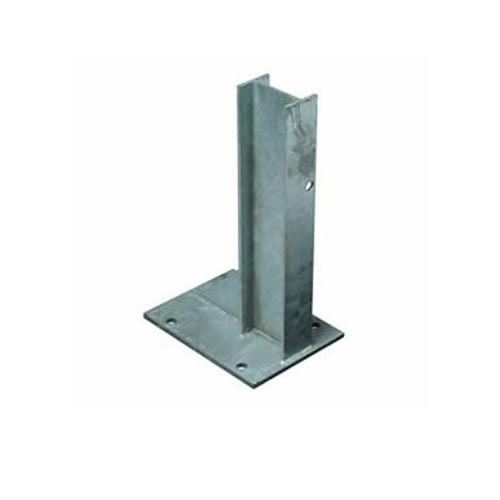
The H post is the heavier profile: 19.3kg at 1.2m, 24.1kg at 1.5m and 28.9kg at 1.8m dig in, or 18.3kg and 21.5kg base plated at 560mm and 760mm. More post in the ground and more section resisting the hit.
Specify it where the thing behind the barrier is expensive, dangerous or structural — racking, plant, a column holding up a roof, a gas or electrical installation, a building line that HGVs manoeuvre against. The extra cost is small next to the consequence.
Head to head
| Z post | H post | |
|---|---|---|
| Section | 100 x 50mm | Heavier H profile |
| Dig in options | 1.2m overall | 1.2m, 1.5m, 1.8m overall |
| Weight, 1.2m dig in | Lighter | 19.3kg |
| Bolt down options | 560mm, 760mm overall | 560mm, 760mm overall |
| Right for | Low-speed knocks | Real impact, and what is behind matters |
Dig in or bolt down
Dig in is the stronger detail and the cheaper part: the post is concreted into the ground and the ground does the work. Bolt down exists for the situation where you cannot dig — an existing slab, a deck, a basement car park, anywhere breaking the surface is not an option.
Bolt down is a real detail, not a compromise, but it moves the weak point to the concrete. A base plate on a thin or cracked slab, or too close to an edge, will pull out before the post bends. If the slab is questionable, dig.
Finish
Both profiles are hot dip galvanised as standard, which is what you want on the part of the run that is buried or bolted down. Powder coating is available to order in over 620 colours where the barrier has to match a site or brand scheme — it goes on top of the galvanising, so nothing is given up.
Products covered in this guide
Frequently asked questions
- Is an H post stronger than a Z post?
Yes — it is the heavier section and comes in longer dig-in lengths, so there is more post in the ground and more resistance to a real impact. The Z post is sized for low-speed knocks in car parks and yards.
- What heights do crash barrier posts come in?
Z post: 1.2m dig in, or 560mm and 760mm bolt down. H post: 1.2m, 1.5m and 1.8m dig in, or 560mm and 760mm bolt down. All quoted overall, not above ground.
- Can I bolt crash barrier posts to an existing slab?
Yes, using the base plated versions and anchor bolts sized to the post and the concrete. The slab has to be sound, thick enough and not cracked or edge-close at the fixing points — otherwise the plate pulls before the post bends.