


Palisade
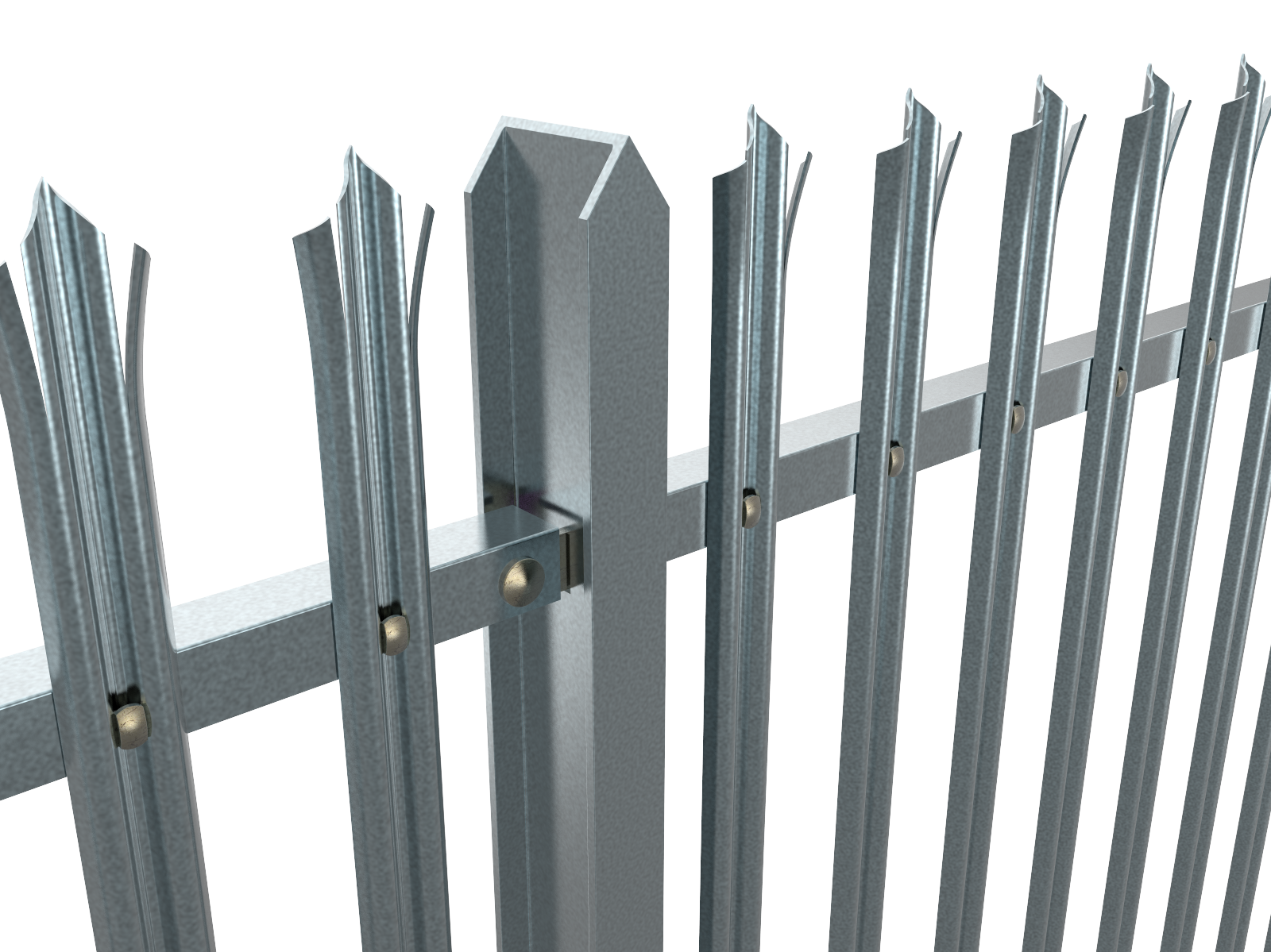
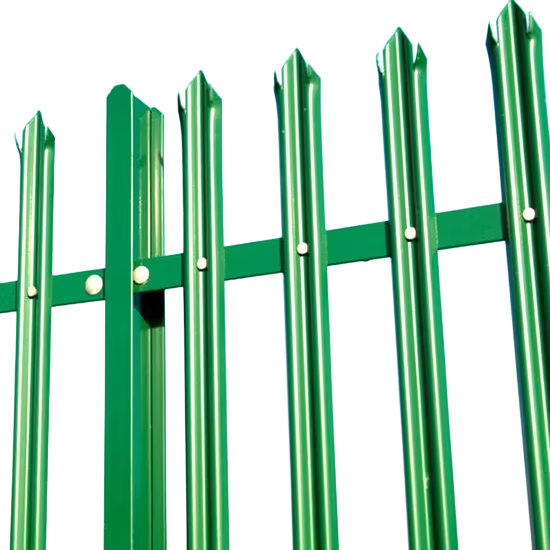
Security fencing built from vertical steel pales bolted to horizontal rails. The pointed tops and bolted construction make it hard to climb and hard to dismantle.
Also called: palisade fencing, steel palisade, steel palisade fencing, palisade fence
Palisade is the default choice for a commercial or industrial perimeter in the UK, and it earns that on three counts: it is hard to climb, hard to take apart, and easy to repair a section of without replacing the run.
How it goes together
A palisade fence is built up rather than dropped in as panels. Two horizontal rails span between posts, and the pales bolt through those rails one at a time. That is why palisade is quoted by the bay — a bay being one full span of pales, rails and fixings between two posts.
Because every pale is an individual bolted component, a damaged section can be unbolted and replaced on its own. A welded panel system usually means swapping the whole panel.
Pale profiles
Pales come pressed into one of two profiles, and they are not interchangeable — each takes its own bolts:
- W-section — more folds, stiffer, the usual specification for security work.
- D-section — a rounded profile, slightly lighter, and often chosen on appearance.
Tops are normally triple-pointed, which removes anywhere to get a hand or a foot over. Round-top pales are available where the fence faces the public and the points would be a hazard.
Finish
Standard palisade is hot-dip galvanised, which protects the cut edges and the folds as well as the flat faces. Powder coating goes on top of the galvanising in any RAL colour where the fence needs to match a building or a site standard.
Fixings
Palisade is bolted throughout, which is a strength and a weakness — a fence held together with ordinary nuts can be taken apart with an ordinary spanner. Snap-off nuts shear as they are tightened and leave nothing to grip, which is what makes the finished fence tamper-proof.
Palisade products we stock
Frequently asked questions
- What heights does palisade fencing come in?
Standard steel palisade runs from 1.2m up to 3.0m high. 1.8m suits most commercial boundaries, 2.4m is the usual specification for schools and compounds, and 3.0m is reserved for maximum-security perimeters. Every height uses the same bolted pale-and-rail construction.
- What is the difference between W-section and D-section pales?
The profile pressed into the pale. W-section has more folds, which makes it stiffer, and is the usual specification for security work; D-section is a rounded profile, slightly lighter, and often chosen on appearance. The two are not interchangeable — each profile takes its own bolts.
- How is palisade fencing sold and priced?
By the bay — one complete span of pales, rails and fixings between two posts, typically around 2.75m wide. To work out a run, divide its length by the bay width and round up, then add the posts and fixings. Bulk prices apply as the number of bays goes up.
- Can palisade fencing be powder coated?
Yes. Palisade is hot-dip galvanised as standard and can be powder coated over the galvanising in any RAL colour. RAL 6005 Moss Green is the UK fencing default and usually the quickest option; other colours are coated to order.